
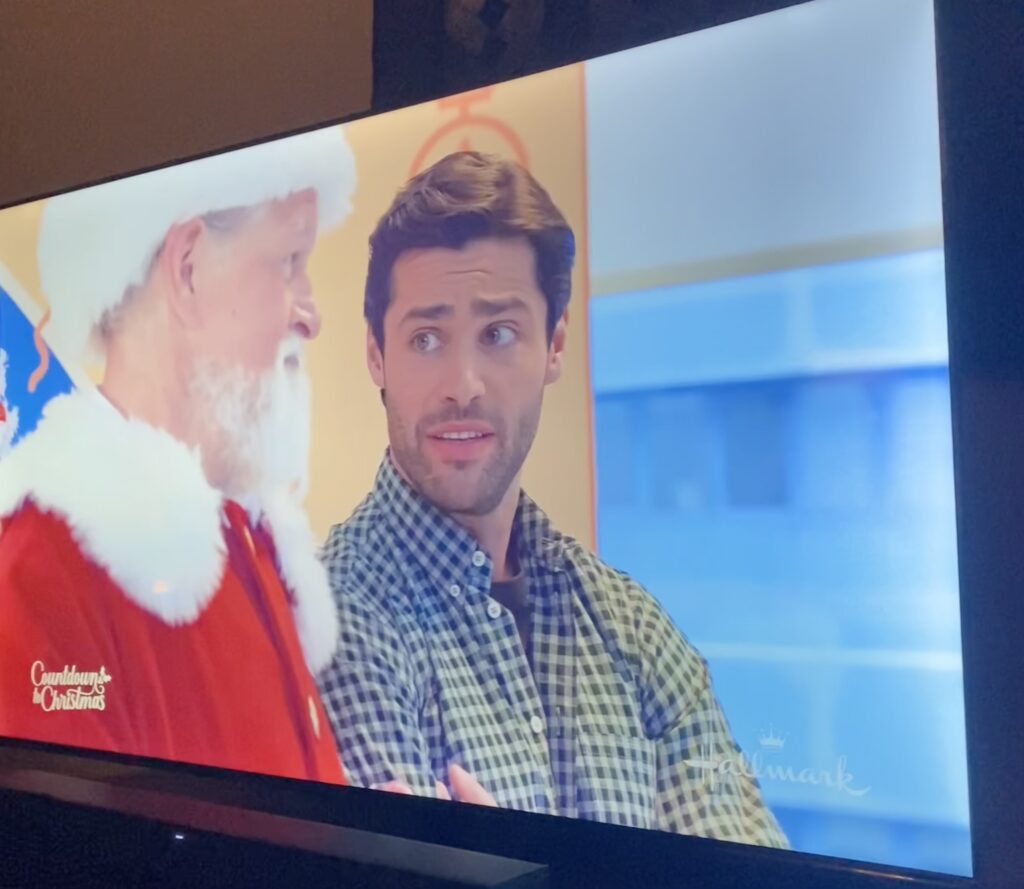
It’s an undisputed truth that Christmas has been converted to a festival of capitalistic commodities. The minute Halloween ends (sometimes earlier), the commercial soundtrack kicks in and the expectation of relentless consumerism starts. Christmas movies are a staple of this; everyone has their favorites (mine is “Klaus”), and many people look forward to the Hallmark Channel’s assembly line of Christmas cheer. Their process is streamlined; a shoot for a single film takes about two weeks and costs under $2 million, with screenwriters earning about $50,000 per script.
In the winter of 2022, I did what any respectable fan of “slop television” and B-List cinema does during the holiday season: I succumbed to the Hallmark Christmas Movie machine. Upon realizing the total number of these movies seemed manageable, a thought occurred: a very normal thought for someone who has never been able to be normal about anything. What if I watched them all?
Like any self-respecting person, I started with a spreadsheet, a complete list of the films and a meticulous grading system:
- Is it worth watching? (Is it worth your time?, not cinematic merit but is it so bad it’s good?)
- Overall Rating (Where the highest score awarded was a generous 5.5/10)
- Adherence to the Formula: Crucial. Measuring how well the film embraced its own cliches, Small-town setting? “Work first,” female lead? A small business needing a Christmas miracle? (Extra points if it’s a Christmas Tree farm or bakery.)
The formula is designed to maximize comfort, selling a guaranteed emotional experience. An anonymous industry source told Bustle, “Many Hallmark films were birthed by producers sitting in a conference room, spitballing catchy movie titles, and then working backward to shape a plotline around the title.”
Specifically trained set designers come in to assure the films have the correct warm, Hallmark feeling and make sure every possible frame is overloaded with Christmas cheer. Many people will play the Hallmark channel in the background throughout the holiday season, and they want to make sure that anytime the viewers so much as glance at the screen, they are overwhelmed with Christmas joy.
Even the cast is the same, some notable names include: Lacey Chabert, the “Queen of Hallmark” having over 40 credits (making her the most credited Hallmark actress). Candace Cameron Bure, best known as DJ Tanner on Full House and who made a switch to the Great American Family network when Hallmark’s new CEO started to use storylines that didn’t align with her beliefs about same sex marriage.
In 2019, Hallmark faced major backlash for pulling an ad for Zola, an online wedding planning business that featured a wedding ceremony between two women. The CEO, Bill Abbot, reversed the decision after the company threatened to pull all their support from the network. A few months later, Bill Abbot stepped down.
His replacement, Wonya Lucas, aimed to tell different types of stories about diverse people. For example, another common stereotype is the “best friend of color” who plays no major role in the story and has no discernible personality. Lucas wanted to step away from these hollow corporate attempts at diversity, stating in an interview with The Hollywood Reporter “There is a difference between representation — “the Black best friend” — and authentic storytelling.” Under her watch Hallmark had its first same sex couple at the forefront of a film in 2020, “The Christmas House” (That was a 4/10 watch from me only being saved by the feature of Jonathan Bennett).
Hallmark isn’t telling a story; it’s selling perfect, artificial holiday ideals. As a corporation in the business of holiday cards and ornaments, the aesthetics of these films are important, with a reported $50,000 spent for each film just for fake snow. Yet, the specific product these movies sell is the rejection of modern ambition. The entire central conflict of the majority of these movies is the heroine’s journey from a high-powered, work-first city life (almost always New York City because, as we know all people from New York are cold, bitter and live unfulfilled lives) to a life of domesticity and “traditional” marriage. When the heroine sacrifices her career for a simpler, maternal life running a bakery, Christmas tree farm, or discovering her new father-in-law is Santa, she is performing a transformation valued by the company and its audience.
An analysis of the strongest viewership for Hallmark, according to the Los Angeles Times, reveals a distinct political slant: The geographic areas where Hallmark programs are most popular closely resemble the Republican strongholds of the 2016 electoral college map. Nielsen data from 2017 confirms this. Hallmark’s ratings are higher by at least 50% in regions outside major liberal urban centers (New York, Los Angeles, and Chicago). In the second quarter of 2017, the Hallmark Channel and its companion network, Hallmark Movies & Mysteries, outperformed their competition. While major competitors struggled with a decline in viewership, Hallmark registered audience growth of 9% and Hallmark Movies & Mysteries a 23% growth.
Ultimately, what my spreadsheet proved is that Hallmark Christmas movies aren’t art; They are a perfectly calibrated commercial product. The channel successfully monetizes a moral high ground of the “true meaning of Christmas” by streamlining production. It also sells a very conservative cultural fantasy: the rejection of modern individual ambition in favor of defined, traditional roles in a small town. And the Nielsen data shows, to me at least, that this fantasy is targeted. Even under Wonya Lucas’ attempt to broaden the product line, the issue remains: the network is still selling you hour-and-a-half-long commercials.
That doesn’t mean I don’t want a piece of that sweet, sweet, Hallmark $50k for a script. So here’s my pitch for my own Hallmark Christmas movie.
As with the real thing, I started with a title: Christmas at Beauty Spot. Holly Reynolds, a Milligan alum from east Tennessee and high-end event planner in New York City, has carefully crafted a life where “holiday season” means luxury galas, celebrity clients and a long-awaited Christmas getaway to the Maldives. So when her ever-kind and full of Christmas cheer former professor, Professor Kringle, invites her to return to Milligan University as a guest speaker, she declines – it’s been years since she’s slowed down long enough to even think about home.
On the morning of her vacation, a chaotic work crisis intervenes: a celebrity winter wonderland wedding she planned falls apart, and Holly gets pulled into managing the fallout. She misses her flight. She decides that she shouldn’t even take the holiday off, so she calls her assistant, Maya, to let her know her PTO is cancelled and they have work to do. Trying to keep her PTO, Maya makes a small comment to make Holly think.
“You plan Christmas for everyone else, but you don’t know what Christmas means anymore.”
Holly decides she needs to prove that she still knows what Christmas is all about. Back in the snowy Appalachians, she’s surprised by how comforting everything feels. She reconnects with her old professor, Professor Kringle, whose uncanny cheer and perfect timing seem almost magical. She also runs into Rowan Nicholas, a former classmate who now owns the coziest coffee shop in town.
As Holly spends time with Rowan and rediscovers her roots, the holiday spirit slowly returns her to her humble, Christmas-loving, traditional roots. Because good people love Christmas. On Christmas Eve at the beloved Beauty Spot on Buffalo Mountain, Holly realizes Professor Kringle isn’t just festive, he’s literally Santa Claus, subtly guiding her home to what really matters.
With the mountains glowing with snow behind them, Holly chooses Rowan over her successful career and everything she’s built for years. Hallmark Licensing, LLC please send all offers to gabriellejones.work@gmail.com, Thank You!
Cover Photo: Hallmark movie (Photo Credit: Emily Haas)