
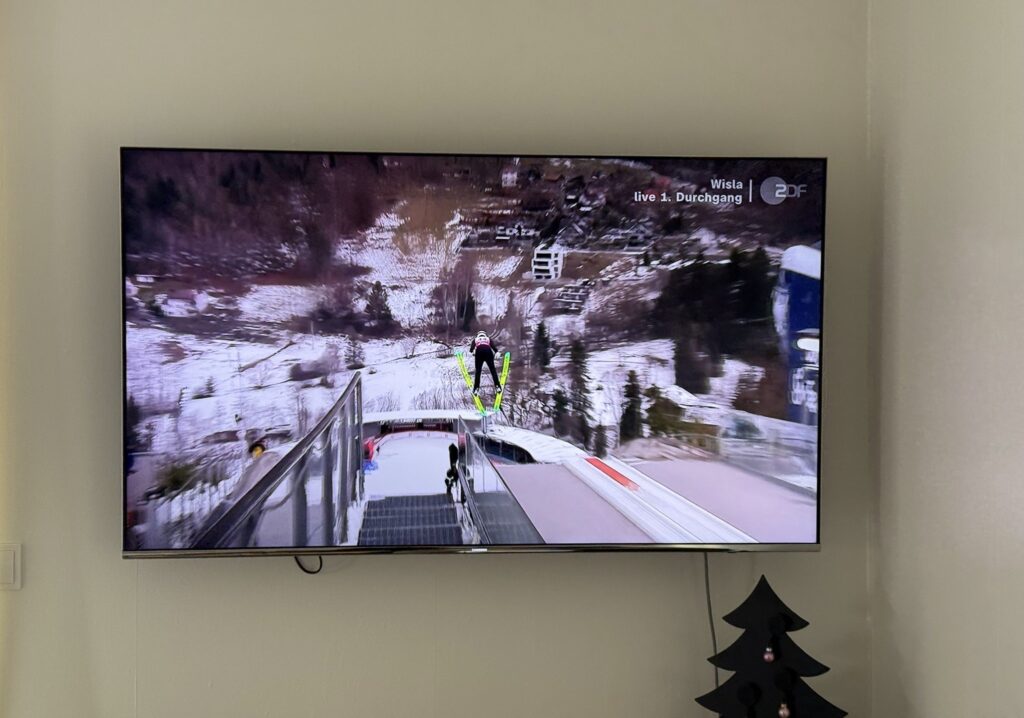
It is a Sunday in December, sometime during the 2010s. Wind blows heavy rain against the window, but inside the living room is heated by the fireplace; the cracking of the burning wood underlines the cozy atmosphere of the season. The living room table is stacked with hot chocolate and gingerbread, while ski jumping runs on TV. A little girl is excited to watch her favorite athletes jump off hills that are between 85 and 109 meters (280-360 feet) high, roughly the length of a FIFA-regulated soccer field. She admires the women on screen, their skills and fearlessness. Just like her mom, cuddled up on the other end of the couch, these women are her role models.
That little girl was me—fortunate enough to grow up surrounded by many female athletes competing in their sports, including ski jumpers. My mom and her generation were not as fortunate. She, like me, watched ski jumping growing up, admiring athletes like Jens Weißflog or Martin Schmitt. In the ’80s, ski jumping was a sport for male athletes only. Women did not get their own world cup circuit until 2011, and their first Olympics were the Games in Sochi in 2014. The upcoming Olympics in Milano Cortina mark the first games in which women can compete on the large hill as well as the normal hill, an event men have had since the games in Chamonix in 1924.
The 2026 Winter Games in Italy will “set to be a landmark Olympic Winter Games for gender equality,” according to the International Olympic Committee. More women than ever are expected to compete in Italy, taking part in more events than at any previous Winter Games, with female athletes predicted to make up 47 percent of the field. Women can compete in 50 women’s-only events as well as 12 mixed events, while male athletes can compete in 54 men’s-only events. Twelve of the 16 disciplines in Milano Cortina will be fully gender-balanced in athlete numbers, which is an increase from Beijing 2022 and a Winter Games record.
Nonetheless, two sports will fall short on equal event numbers. In ski jumping men will compete in one more competition than the women, the Men’s Super Team.
Nordic combined, a sport combining cross-country skiing and ski jumping, faces an even bigger gap, as it is the only Olympic winter sport without women’s events at the 2026 Games.
“We work just as hard as any other athlete and especially just as hard as the men,” said U.S. Nordic combined athlete Annika Malacinski in the documentary “Annika—Where She Lands”. “We deserve to be at the Olympics.”
Men’s Nordic combined has been on the Olympic schedule since the first Winter Games in Chamonix in 1924. Team events joined at the 1988 Games in Calgary, and the 2022 Games in Beijing added another individual event, bringing the total for the games in Italy to three men’s events and zero women’s events.
“It is not like we need different ski jumps,” Malacinski said. “They have ski jumps ready. They have cross-country skiing course venues, and they still choose not to add the women.”
The IOC announced its decision in a press conference in June 2022. Kit McConnell, IOC sports director, explained the decision by citing too-small audiences for the event and a lack of “diversity of countries” taking part.
Nordic combined first established women’s world cup events and world championships in the 2020-21 season, making it a relatively new elite-level discipline compared to the men’s, which debuted in 1983-84.
In 2021, 30 women finished the inaugural world cup season with points scored. Nine nations earned points in the nations cup that season, compared to 11 countries in the 2024-2025 season. Forty-six women finished the last season with world cup points. In comparison, the women’s biathlon world cup, an Olympic sport for women since 1992, had 15 women’s teams compete in the 2024-2025 season. Women’s ski jumping had the same number.
“Women’s Nordic combined is developing little by little around the world, and it’s only logical that women should be able to join the Olympic program too,” French skiing federation technical director Pierre Mignerey told the Associated Press.
In response to the decision, female athletes have been trying to raise awareness, including raising their skiing poles in the air, forming an X, a symbol meaning “no eXceptions,” and drawing mustaches and beards on their faces during World Cup events.
The program for the 2026 Games cannot be changed, but with the Olympics approaching, so is the decision for the program for the 2030 Games in the French Alps. The IOC Executive Board will meet in December to decide on the lineup for 2030, but it is already approved to postpone the decision on Nordic combined until 2026, after data from Milano Cortina is evaluated.
While the IOC could decide to give women a chance to compete at the 2030 Olympic Games, it could also decide to remove the sport from the program entirely, in part to end the conversation about gender inequality. The IOC explained a potential cut with the weak international representation of the sport outside of Europe. During the previous three Winter Games, just four countries won the 27 medals available in the men’s field. The International Ski and Snowboard Federation—along with athletes, coaches, national governing bodies and fans—is fighting to keep Nordic combined in the Olympics.
The question of how the IOC can honestly advertise Milano Cortina as gender-balanced Winter Games even though it denies female athletes their right to compete in a sport in which men have been competing for decades remains.
Malacinski, only 24 years old, worries about the future of her sport.
“How do we motivate the younger generation to want to do something when they are not allowed to compete at the highest level of sport?”
Italy’s Annika Sieff jumps at ski jumping World Cup in Wisla, Poland on December 5, 2025 (by Nicole Haas)