After 33 years of service at Milligan University, Craig Farmer, a longtime figure in the humanities program, will conclude his career at Milligan in May 2026.
Farmer is a professor of history and humanities and the associate dean for the School of Arts and Humanities. His long tenure has spanned significant institutional changes. He notes a particularly positive shift in the student body, a change he credits to the Goah Scholar Program. He says Goah has helped the university “actually fulfill our Christian mission much more faithfully.”
However, not all changes have been easy, especially in the classroom. “I find it increasingly difficult to motivate students to read,” he said. “And I don’t blame them. I blame our culture.”
Farmer’s extensive scholarly work is rooted in his doctoral studies at Duke University, where he specialized in the history of biblical interpretation under the late David Steinmetz. Steinmetz was the Amos Ragan Kearns Distinguished Professor of the History of Christianity at Duke. His commitment to his mentor was absolute: “I didn’t go to Duke to go to Duke, I went to Duke to study with David Steinmetz.”
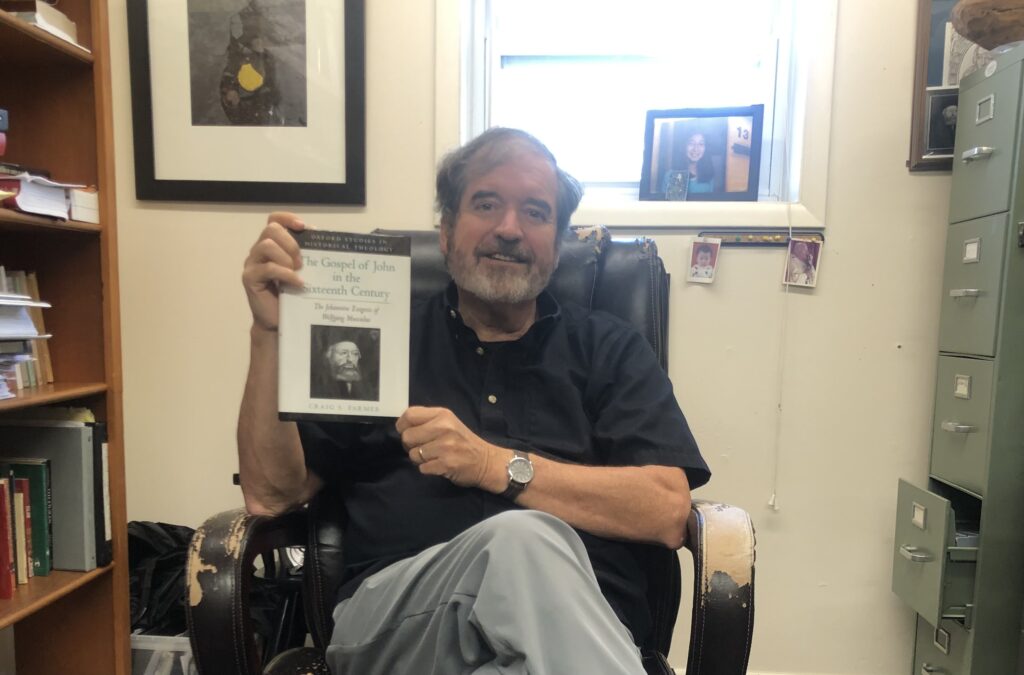
His first book,The Gospel of John in the Sixteenth Century, was a direct result of his dissertation, published in 1997 and was the first volume in the “Oxford Studies in Historical Theology” series. He recalls the intense refinement required: “There was a lot of work getting it down from that huge thing down to that book.”
Later in his career, Farmer took on the monumental task of translating from Latin for the Reformation Commentary on Scripture. This required a yearlong sabbatical in Europe and a second unpaid leave of absence to complete. He was assigned the first 12 chapters of John, meticulously translating biblical interpretations from the ancient, medieval, and Reformation eras, verse by verse.
Yet, of all his publications, he expresses the most pride in a single article published in the journal of the American Society of Church History-a publication that, in his words, signifies “you’ve made your mark.” He wrote “Changing Images of the Samaritan Woman in Early Reformed Commentaries on John.”
When asked about his most significant legacy, Farmer said: “To help expand the world of my students’ minds.” His goal is not to change their perspectives, but “to allow them to see and honestly engage other perspectives.”
This mission is most evident in his Islam class, which he has taught for the past 25 years despite being “way outside my expertise.” He feels called to teach it as a fulfillment of Christ’s command, “to learn to love our neighbors.”
Ultimately, Farmer says the enduring constant of his long career is his deep affection for his students: “I love my students. They’re the reason I’m here. They bring me joy, they challenge me to try and think creatively.”
Beyond the campus, Farmer has actively engaged the broader community, working with local churches and being invited by the American Red Cross to speak to their volunteers about Islam. He looks forward to continuing this work in retirement: “My hope is that after I retire and I no longer have the joy of young 20-year-old Millligan students to teach, I’ll find more opportunities to teach in churches.”
Cover Photo: Farmer holding his first book, Photo Credit: Gabrielle Jones