
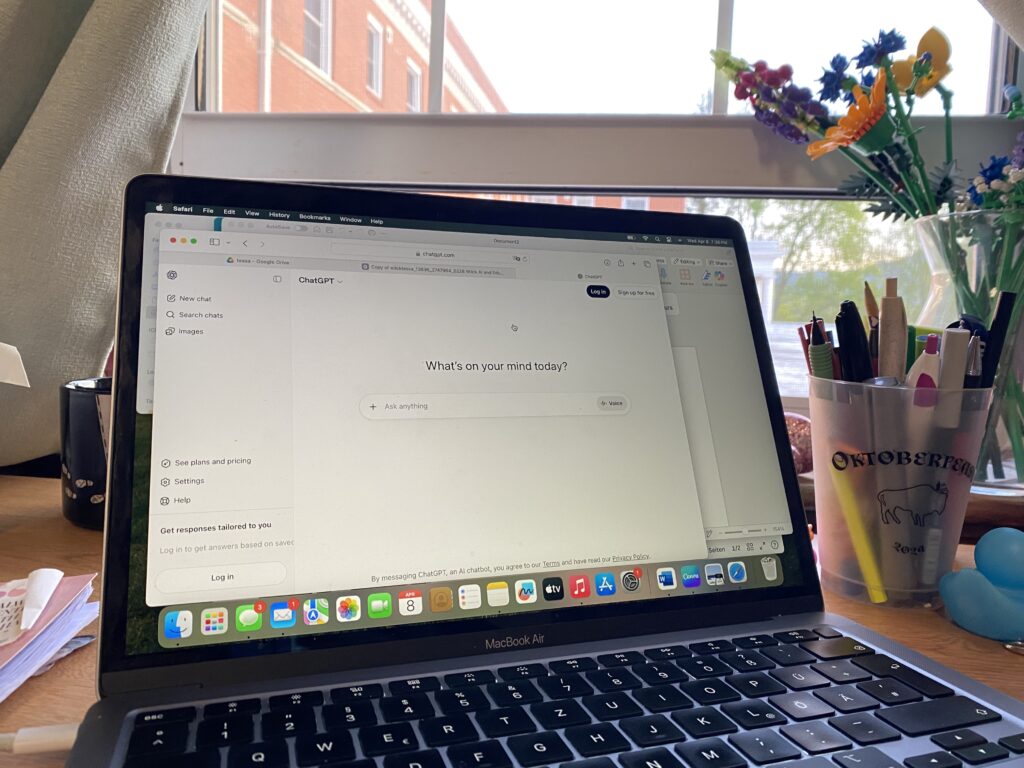
The lives of many students changed significantly with the release of ChatGPT in November 2022. While initial reactions to artificial intelligence in education were cautious and uncertain, AI has since become an integral part of academic life. Today, schools and universities are increasingly confronted with both the opportunities and challenges of AI use.
According to a study by Forbes, around 90% of students at American universities now use AI for academic purposes, a number that continues to rise. This rapid development raises important questions about the role of AI in education.
From the student’s perspective, the use of AI in education does have advantages and disadvantages. On the one hand, AI tools can help students better and more quickly understand difficult content, structure their learning and provide fast feedback.
“I think it’s okay to use it when you use it for studying. For example, for nursing, I’ll ask it to explain a concept and give me examples of it,” said one Milligan student. “I think it feels like cheating when you use it and claim what AI gave you as your own, such as writing an essay using AI, because it’s not written entirely by you.”
However, AI can also be more than just an additional help to solve one problem. It can be like a study buddy that helps you at any time and is constantly improving. No professor can be at multiple places at once. AI can.
“AI is getting better at educational dialogue, too, meaning not only can it ‘get the answer right,’ it can also ask good questions to help assess understanding and push students into thinking deeper about concepts,” said Ian Lundholm, professor of mathematics.
So why worry when AI is the perfect partner for learning? Unfortunately, the line between useful assistance and quickly copying AI-generated text is often blurred. And as soon as these boundaries are crossed, one’s own critical thinking and ability to state an opinion can be lost.
With the increasing use of AI, questions are also arising about what education actually means. Learning and studying do not simply mean producing efficient results, but actively engaging in the process of thinking, writing and understanding. Higher education depends on these processes, which are often challenging and time-consuming.
“I would argue that we need to return to the concept of ‘efficiency’ and what it means to be ‘human’ to salvage what truly matters,” said Michael Blouin, professor of English and humanities.
Another issue that occurs with AI in higher education is the difficulty for professors to determine whether a student did their work independently or with the help of AI.
“I personally don’t feel pressured to use AI because other students use it, I just think that it’s unfair to the students who actually do their work by themselves and not use AI but get a grade lower than the students who used AI,” said another student.
It is increasingly difficult to assess whether a piece of work reflects a student’s actual understanding. This can lead to uncertainty in evaluation and less trust in the relationship between examinations and performance assessment.
“I think it’s really difficult to tell when someone has used AI. For essays, we need to start requiring students to write in class and to turn in rough drafts so that we can see and grade their work in progress all the way to the final draft,” said Kenny Suit, professor of cinema.
It is almost impossible to predict exactly what will happen in the next five to 10 years, but one thing is certain: AI will be an integral part of our lives. It is up to us to use this tool responsibly and fairly.