
Studying in the United States brings both opportunities and challenges for international students. Milligan University serves as a second home for students from around the world, bringing diverse perspectives to campus and classrooms. Differences in expectations, standards and requirements shape the transition many international students experience.
Sophomore Emily Haas of Hildesheim, Germany, compares Milligan to her experience back home.
“German universities often don’t have attendance policies, lectures are held in big auditoriums and your final grade is often determined by one exam at the end of the semester,” Haas said. “When I talked to my mom, who studied business at the University of Cologne, about Milligan for the first time, she was shocked by the student population. Her major alone had more people than all of Milligan’s undergraduate and graduate students together.”
According to Becky Robertson, associate registrar and primary designated school official for international students, Milligan has 99 international students, including 85 active students and 14 on optional practical training. OPT status allows F-1 visa international students to work in the United States for up to one year.
Milligan represents 40 different countries in its student body as of the spring 2026 semester. The top three countries include Germany with 14 students, the United Kingdom with 12 students and Spain with nine students.
International students often encounter a different academic style compared with that in their home countries. Classroom size, teaching style and workload are common differences highlighted by international students.
Senior Nicolas Moshe Motau Jr. of South Africa said that in his home country, classes are usually bigger.
“Teachers do not have a deep connection with their students like here at Milligan,” Motau said. “But at home, technical experience is prioritized more to integrate what we learn into the real world while learning it.” He added that school in South Africa runs year-round and that the content is often more difficult.
In contrast, Joselin Martinez, a senior from El Salvador, said schooling in the United States feels more challenging.
“At home you don’t necessarily have school the whole day until you go to high school or college,” Martinez said. “In elementary or middle school, you either go in the afternoon or in the morning.”
David Siebenaler, instructor of history and humanities, has taught a range of international students during his time at Milligan.
“I try to be more attentive to their perspectives on Western, especially American, history and culture. When we cover material that focuses on their specific national or cultural background, I invite those students to offer corrections or additional information that may enhance the classroom discussions,” Siebenaler said. “I also try to be more aware of using idiomatic expressions that create barriers to communication.”
Robertson said she often encourages international students to use tutoring, the Writing Center and the Counseling Center when they feel they need additional support.
Siebenaler added that academic support is critical, especially for students balancing athletics or heavy workloads.
“I feel that it is incumbent on me as a teacher to help them navigate the linguistic challenges that they might face, especially when it comes to writing essays for exams or other written assignments,” Siebenaler said. “Since many are also athletes, time management is a major issue as well. The humanities program involves a significant amount of reading, so completing those reading assignments might be more time-consuming for those international students whose first language is not English.”
Beyond academics, cultural adjustments themselves can be more challenging and take a toll on students’ mental health.
“Most of my experience has been people here being individualistic, making it hard to socialize,” Motau said. “At home, it’s very hard not to. We have a word, ‘ubuntu,’ which means ‘I am because we are.’ This very line is why we as South Africans are very outgoing, we try to build relationships with everyone in any community, and it has been very misunderstood when I do it here. That just makes it hard.”
Martinez makes a similar connection to Motau’s point, saying her home country strongly emphasizes family and relationships.
“Back home, family is closely tied, and I think that is one of the things that I miss,” Martinez said. She added that cultural habits sometimes affect her day-to-day life.
“I was taught that you don’t eat until everyone sits down and has their food,” Martinez said with a laugh. “One time we went out to eat with older people, and my friends were eating and finished before they even got their food. They asked me why I wasn’t eating yet, and I had to explain that I was waiting.”
Motau also noted food as a major cultural difference between the United States and South Africa.
“Most of what we eat is non-processed, no unnecessary preservatives and extra sugars added, and so forth. On top of that, the norm of how to eat this is always in its healthiest way; such as grilling as opposed to frying, and natural-blend drinks as opposed to fizzy drinks,” Motau said. “I always lose weight just from diet change alone whenever I go back to Africa, because of what we eat.”
To help navigate these challenges early in the school year, Milligan holds an international student welcome luncheon during the second week of classes. The event connects students with campus resources and other international students, Robertson said. Gift bags are included at the luncheon with items such as toiletries, towels, sheets and blankets.
Despite the challenges, students say the experience is worth it.
“Overall, the experience has shown me perspectives I never could have imagined existed,” Motau said. “It showed me just how privileged I am to be where I am, to be who I am and to have the people around me.”“Living abroad changed me in ways I can’t even describe,” Haas said. “I think it made me a better person overall, simply because it taught me to listen and to put myself in other people’s shoes. I think the world could be a better place if everyone tried that at least once in their life.”
“Don’t be scared, I remember I almost didn’t come because I was so scared,” Martinez said. “It can be hard, of course, but throughout doing this you get to meet so many people from so many different places and you get to learn about different cultures other than your own. I would say go for it.”
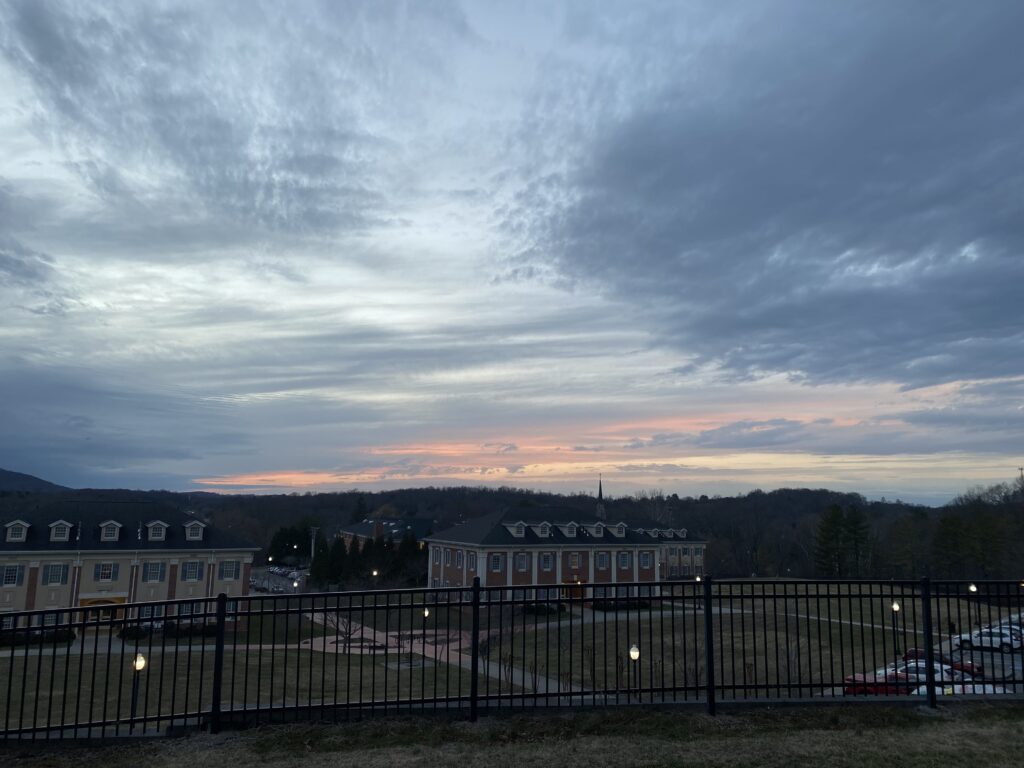
Photo: Milligan Village (Photo Credit: Emily Haas)